فارسی
فارسی  العربية
  Русский
  Azərbaycan
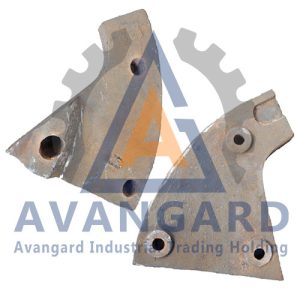
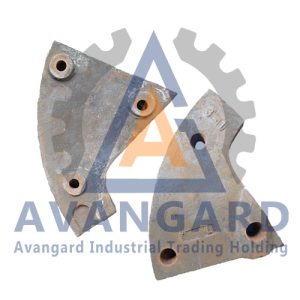
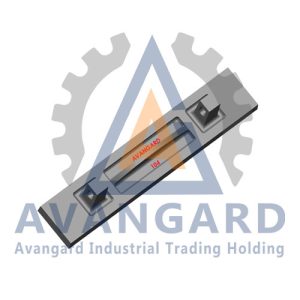
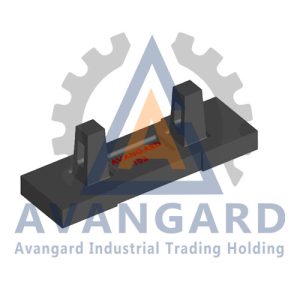
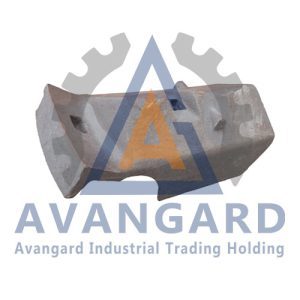
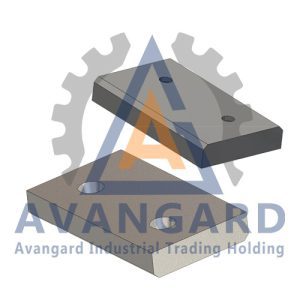
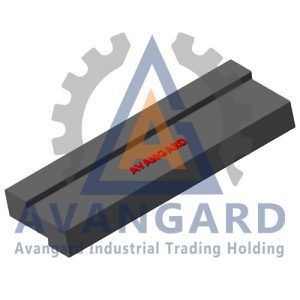
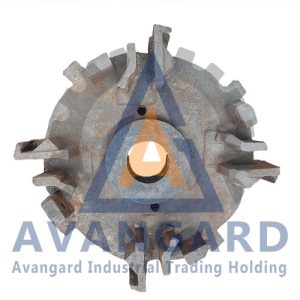
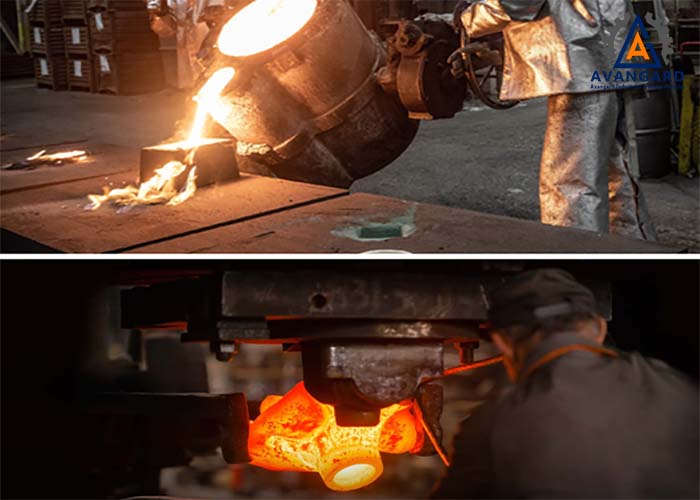
Forging is an industrial process in which metal is subjected to pressure and impact, gradually forming into the desired shape. Due to its significant improvement in strength and durability, forging is widely applied across various industries. At Avangard Holding, the choice of forging method depends on the specific application of the part, relying on three main approaches:
- Temperature-based forging – including hot forging and cold forging for optimal metal deformation.
- Process-based forging – open-die or closed-die forging, depending on part requirements.
- Material-based forging – applied to steel, aluminum, brass, and other alloys.
The main stages of the forging process are:
- Heating the metal: The metal is heated to the proper temperature to improve its plasticity.
- Force application and shaping: Using an industrial hammer or press, force is applied to shape the metal according to the mold design.
- Cooling: The shaped component is gradually cooled to stabilize its structure and maintain mechanical strength.
This manufacturing method, especially in the automotive, aerospace, and heavy machinery industries, ensures the production of high-strength parts with long service life. By applying advanced forging techniques, Avangard Holding guarantees dimensional accuracy and superior quality in every component produced.
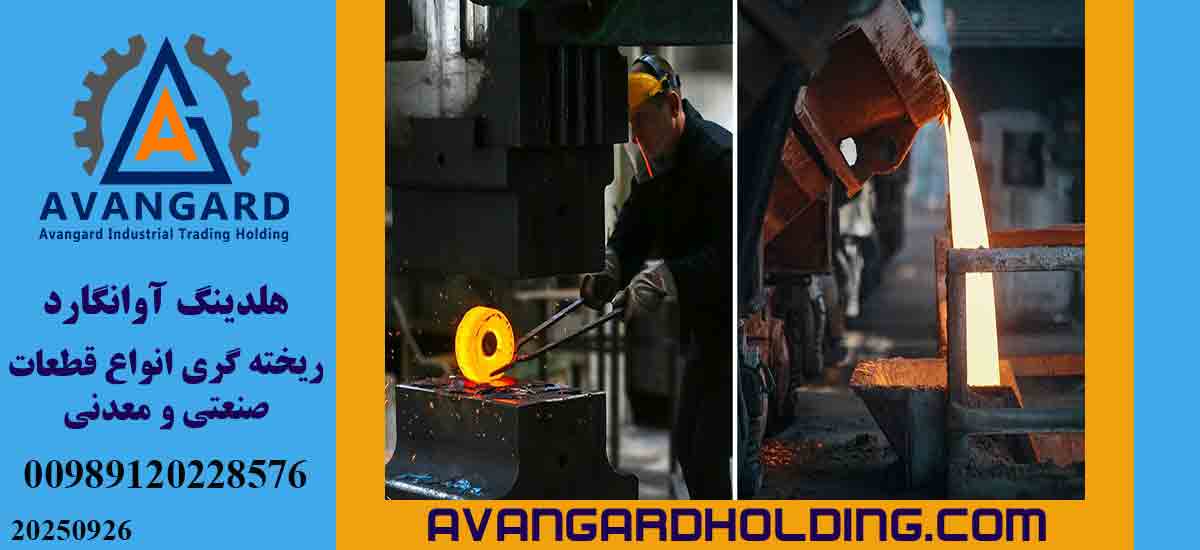
Forging vs. Casting: Advantages, Limitations, and Applications
Just as understanding the advantages of casting is essential to distinguish between forging and casting, recognizing the unique benefits and limitations of forging also helps engineers and industrial designers select the most suitable production method for their specific needs.
Forging offers exceptional strength and durability, a homogeneous internal structure free of defects, and superior dimensional accuracy compared to casting. For this reason, forging is widely used in metallurgy and in the production of high-performance, precision-critical components.
However, certain limitations must also be considered:
- Complex geometries: Forging is not well-suited for manufacturing components with highly intricate shapes.
- Specialized equipment and workforce: Advanced industrial hammers and presses, along with skilled operators, are required.
- High tooling and equipment costs: The initial investment in forging dies and tools is higher than in some other manufacturing methods.
Taking these factors into account, Avangard Holding leverages advanced forging technologies to produce industrial parts with exceptional quality, precise dimensional accuracy, and extended service life. This makes forging a highly reliable choice for industries such as automotive, aerospace, and heavy machinery.
Forged Flange or Cast Flange? A Guide for Industrial Applications
Flanges are critical components in piping systems and industrial equipment, serving as essential connectors for pipes, valves, and other machinery. The choice between a forged flange and a cast flange depends directly on the specific application, operating conditions, and mechanical requirements.
A specialized and practical comparison between forged flanges and cast flanges is presented below:
| Feature | Forging | Casting |
| Advantages | High strength, crack resistance, suitable for high-pressure applications, uniform mechanical properties, improved machinability, variety in raw materials | Capability to produce complex shapes, lower production cost, flexibility in choosing raw materials, ability to achieve different mechanical properties, material efficiency, production of thin-walled components |
| Disadvantages | Higher production cost, limitations in size and shape, high labor and energy requirements, design and complexity restrictions, need for secondary operations, limited control over metallurgical structure | Possibility of internal defects, lower strength, limited control over mechanical properties, need for precise and high-quality molds, high initial equipment cost, longer production time |
Based on the table above, forged flanges are recommended for high-pressure applications and critical environments due to their high strength and uniform mechanical properties, whereas cast flanges are more suitable for components with complex shapes and for cost-effective production.
Avangard Company, leveraging advanced forging and casting technologies, provides the capability to manufacture flanges with high quality, precise dimensional accuracy, and long-lasting durability, making them an ideal choice for the Oil and Gas Industry, petrochemical, and heavy machinery industries.
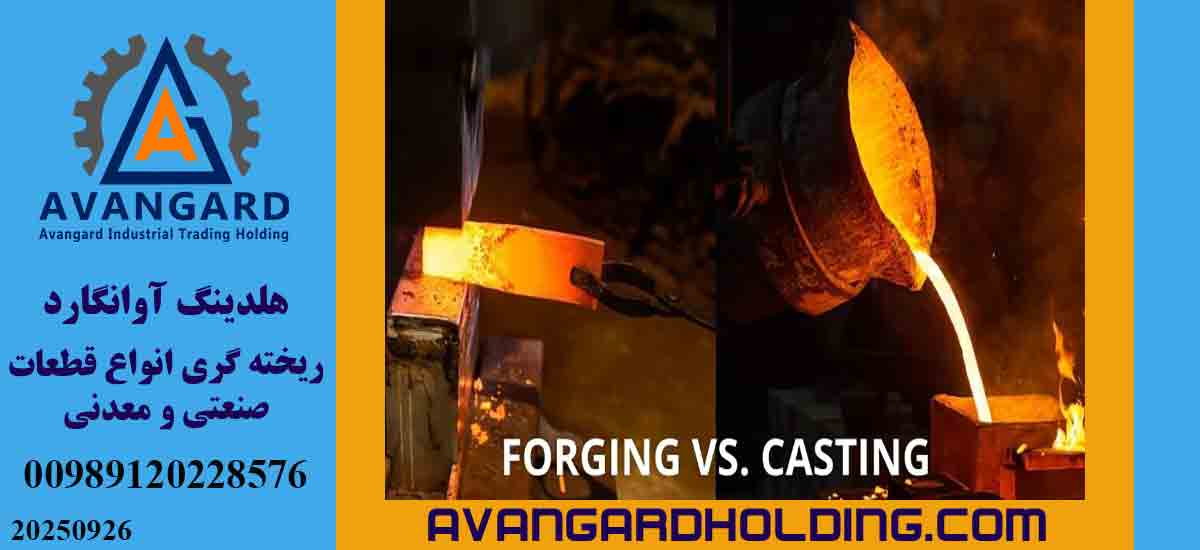
Differences in Applications of Forging and Casting: A Guide to Choosing the Right Method
One of the best ways to understand the differences between forging and casting is to consider their industrial applications. Workshops and manufacturing companies select these processes for metal melting and component shaping based on their production needs and capabilities.
The table below summarizes the main differences between forging and casting in terms of their applications:
| Application Type | Forging | Casting |
| Automotive | Manufacturing automotive components, producing car engines | Automotive industry |
| Aerospace | Aerospace components | Aerospace industry |
| Oil & Gas | Petrochemical and oil industries | Oil and gas industry |
| Industrial Machinery & Equipment | Industrial equipment and heavy machinery | Heavy industry and machinery |
| Decorative & Artistic Industries | – | Production of decorative and artistic components |
As observed, forging is suitable for manufacturing components that require high strength, precise dimensional accuracy, and long-lasting durability, whereas casting enables the production of parts with complex and diverse shapes, making it highly applicable in the decorative and artistic industries.
Avangard Company, leveraging advanced technologies in both methods, provides the capability to produce high-quality components tailored to the needs of various industries, ranging from automotive and aerospace to oil, gas, and heavy machinery.
Characteristics of Forging and Casting: A Specialized Comparison of Metal Forming Methods
Another important aspect of understanding the differences between forging and casting is evaluating the key characteristics of these two methods in the metal melting and forming process. A precise understanding of these features helps engineers and manufacturers select the most suitable method based on performance and economic requirements.
The table below provides a specialized comparison of forging and casting in terms of their key characteristics:
| Feature | Forging | Casting |
| Strength | High | Medium |
| Dimensional Accuracy | Higher | Lower |
| Component Complexity | Limited | High |
| Tooling Cost | High | Medium |
| Internal Defects | Fewer | More |
As observed, forging, with its higher strength, superior dimensional accuracy, and minimal internal defects, is an ideal choice for critical and high-pressure components, whereas casting is suitable for producing complex parts with lower tooling costs and greater design flexibility.
Avangard Company, leveraging advanced technologies in both methods, enables the production of industrial components with high quality, precise dimensional accuracy, and long-lasting durability, making it a reliable choice for the automotive, aerospace, oil and gas, and heavy machinery industries.
Avangard: The Most Trusted Online Platform for Casting Services
Organizations familiar with the differences between forging and casting can take advantage of the most efficient solutions for metal melting and component production. Avangard Company, with extensive experience in providing metallurgy industry services, delivers your orders precisely according to technical drawings and specifications in the shortest possible time.
By offering specialized consultations and utilizing an online order registration system on its website, Avangard provides a fast, secure, and efficient platform for industries and workshops. Through Avangard’s online services, businesses in the casting sector can reduce costs and achieve high-precision, high-quality production processes.
🏢 Avangard Industrial Trading Holding Company – A pioneer in supplying and manufacturing casting parts in the Middle East 🌍
📞 Phone: +98 912 022 8576
🌐 Website: En.Avangardholding.com