فارسی
فارسی  العربية
  Русский
  Azərbaycan

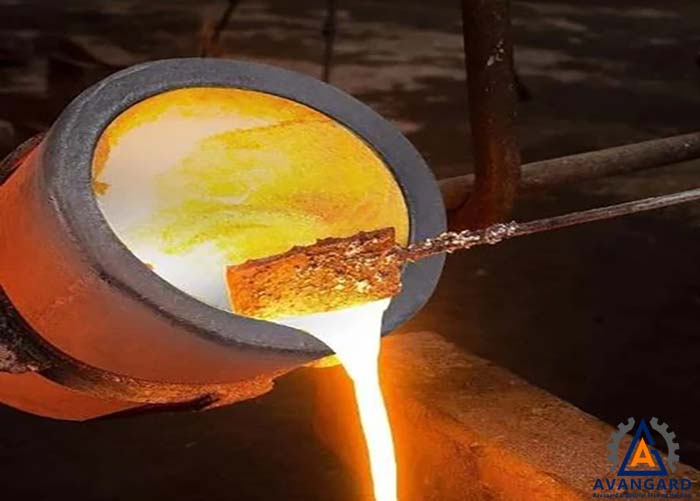
Copper casting is considered one of the most important branches of metalworking. In this process, Copper is melted and poured into pre-designed molds, and after cooling, it takes the desired shape and dimensions. This method holds a significant place in various industries because it allows the production of complex parts that are difficult or even impossible to manufacture through machining or conventional forming techniques.
Stages of the Copper Casting Process
The copper casting process involves several fundamental steps, each of which has a direct impact on the final quality of the product:
- Mold Design and Preparation – Selecting the proper mold material and shape based on the requirements of the final part.
- Metal Melting – Heating copper in specialized furnaces until it reaches the molten state.
- Pouring the Molten Metal – Carefully transferring the liquid copper into the mold with high precision.
- Solidification and Cooling – Gradual cooling of the molten copper to form a solid structure.
- Final Finishing – Post-processing operations such as cutting, surface finishing, and quality inspection.
These stages form the foundation of copper casting and ensure that the final parts meet both structural and dimensional requirements.
Common Methods of Copper Casting
- Sand Casting and CO₂ Process Sand casting is one of the oldest and still widely used copper casting methods. In this process, the mold is made of sand, and after pouring the molten copper, the desired part takes shape. Its main advantage is the low production cost for limited quantities, although its dimensional accuracy is lower compared to other methods. The CO₂ process improves accuracy by adding sodium silicate to the sand mold, which hardens when exposed to carbon dioxide gas.
- Shell Molding (Shell Mold Casting) This technique offers higher precision than traditional sand casting. High-quality sand and synthetic resins are used, resulting in parts with superior surface finish and excellent dimensional accuracy. Although mold production costs are higher, shell molding is highly economical for mass production.
- Die Casting (High-Pressure Casting) In this method, molten copper is injected into a metal mold under high pressure. This ensures parts with very smooth surfaces, tight dimensional tolerances, and enhanced mechanical strength. It also allows the reduction of wall thickness and overall weight of the cast parts.
- Permanent Mold Casting (Chill Casting) Applied in the industry for more than half a century, this process accelerates solidification and improves the mechanical properties of the product. Parts produced by permanent mold casting are usually harder and more durable than those made through sand casting.
- Centrifugal Casting In centrifugal casting, the molten copper is forced against the mold walls by centrifugal force, which results in higher density and reduced porosity. This method is commonly used for manufacturing cylindrical components such as bushings, pipes, and bearings.
- Continuous Casting Continuous casting is a relatively modern method for producing copper-based alloys. It produces parts with higher density, improved surface quality, and fewer defects, while also reducing the need for extensive machining.
- Investment Casting (Lost-Wax Casting) Due to its superior precision and excellent surface finish, investment casting is widely used in advanced industries. Wax or plastic patterns play a key role in this method, and their quality directly affects the final product.
- Plaster Mold Casting This method enables the production of small to medium-sized copper parts with smooth surfaces and high dimensional accuracy. The plaster molds are expendable, making the process suitable for low-volume production.
Comparative Table of Copper Alloys, Applications, and Casting Methods
| Category | Description / Examples | Properties | Industrial Applications |
| Pure Copper | Electrolytic Tough Pitch (ETP) Copper | Very high electrical and thermal conductivity | Electrical wires and cables, heat exchangers |
| Brass Alloy (Copper–Zinc) | Combination of copper and zinc | Corrosion resistance, good formability | Decorative parts, pipe fittings, tools |
| Bronze Alloy (Copper–Tin) | Combination of copper and tin | High strength, wear resistance | Bearings, ship propellers, industrial tools |
| Sand Casting | Sand mold | Cost-effective, suitable for large parts | Heavy and industrial components |
| Investment Casting | Wax/ceramic mold | High dimensional accuracy and excellent surface quality | Complex and intricate parts |
| Centrifugal Casting | Rapid mold rotation | Dense structure, free from porosity | Bushings, pipes, cylindrical parts |
Applications of Copper Casting in Industry
Copper casting and its alloys are widely used across various industries, including:
- Pipes and Fittings – Offering high corrosion resistance and excellent thermal conductivity.
- Electronics Industry – Used in cables, generators, and printed circuit boards (PCBs).
- Jewelry and Handicrafts – Production of copper utensils, decorative items, and sculptures.
- Food Industry – Manufacturing cookware with uniform heat distribution.
- Marine and Automotive – Ship propellers, engine components, and radiators.
- Industrial Machinery – Gears, brakes, and power transmission shafts.
Advantages of Copper Casting
- Excellent electrical and thermal conductivity
- High resistance to corrosion
- Superior machinability
- Recyclable and environmentally friendly
- Suitable strength and durability under various working conditions
- High flexibility in forming processes
- Cost-effective for producing a wide range of components
Furnaces Used for Copper Melting
Two main types of furnaces are commonly used:
- Fuel-Fired Furnaces (Gas and Oil-Fired) – Known for their high capacity.
- Induction Furnaces – Significantly reduce melting time and generate less pollution.
Avangard: A Leader in the Copper Casting Industry
If you are looking for a professional center for copper casting, Avangard is your best choice.
- With over a quarter of a century of experience and a team of experts, Avangard guarantees quality.
- Utilizing modern equipment enables the production of components with high precision and international standards.
- Accuracy, durability, and premium quality have distinguished the Avangard brand in this field.
🏢 Avangard Industrial Trading Holding – A Leader in Casting Parts Supply and Production in the Middle East 🌍 📞 Phone: +98 912 022 8576 🌐 Website: En.Avangardholding.com