 فارسی
فارسی  Arabic
  Russian


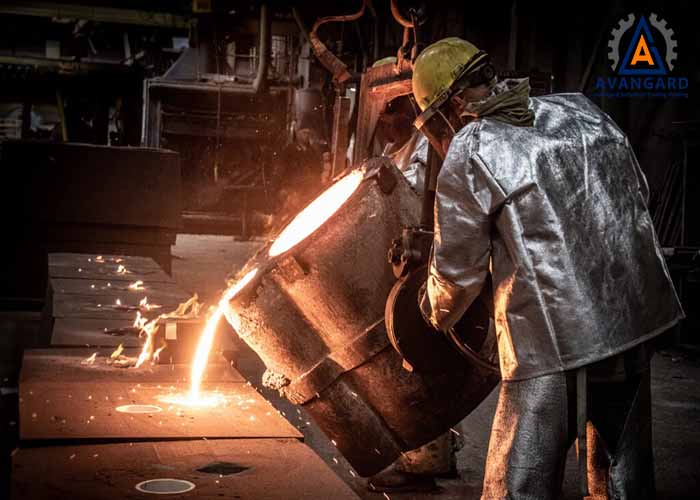
In the casting process, it is possible to enhance the mechanical properties of cast components even while the metal is still in its molten state by adding small amounts of specific elements. The most effective way to achieve this is through the use of inoculants in foundry casting. These elements are typically introduced during the final stage of melt preparation, just before pouring the molten metal into the mold.
In general, the elements contained in Avangard’s inoculants refine the grain size within the microstructure of the casting and promote the formation of phases that would not normally develop during solidification without their addition.
The use of inoculants is also very common in cast iron(Cast Iron Casting) production. For instance, applying these products plays a critical role in the inoculation process of ductile iron. Avangard’s inoculants are usually produced based on a ferrosilicon alloy combined with alloying elements such as Strontium (Sr), Calcium (Ca), Barium (Ba), Zirconium (Zr), and Aluminum (Al). The interaction of these elements with impurities such as sulfur and oxygen, and their subsequent removal from the molten metal, provides favorable nucleation sites for graphite formation and significantly improves the mechanical properties of the alloy.
The table below introduces the different types of Avangard inoculants along with their chemical compositions and primary applications:
| Type of Inoculant | Chemical Composition | Applications |
| Ferritic | Ti, Zr, B, Nb | Components requiring high hardness |
| Graphitic | FeSi, CaSi, Sr, Ba | Casting of gray cast iron |
| Ceramic | Al₂O₃, SiC, TiC | Components designed to operate at high temperatures |
| Nickel-based | Ni, Co | Nickel-based alloys for the oil and gas industry |
| Phosphorous-based | CuP, NiP | Complex castings requiring high dimensional accuracy |
Chemical Composition of Inoculants in Casting
Avangard’s inoculants in foundry casting typically consist of ferrosilicon combined with key alloying elements such as Zirconium (Zr), Strontium (Sr), and Barium (Ba). The precise chemical composition of these elements with ferrosilicon, as well as their optimized percentages, results in the production of various inoculant types with distinct characteristics and applications. Some examples of Avangard inoculants include:
- Zirzinoc Inoculant: contains Zirconium
- Supersid Inoculant: contains Strontium
- Barium-based Inoculant: contains Barium
Performance of Inoculants in Casting
The use of Avangard inoculants in casting significantly refines the grain size of the microstructure and facilitates the formation of phases that would not normally appear during the solidification of the molten metal without their addition. This process leads to a remarkable improvement in the mechanical properties of cast components.
The final performance of an inoculant depends on several factors. For example, process temperature and the size of the initial grains play a crucial role in determining efficiency. If the casting structure is very fine-grained, the initial dissolution of the inoculant occurs quickly, maximizing its effectiveness. However, in coarse-grained structures, inoculant dissolution may be delayed, resulting in reduced product efficiency.
Effect of Elements on the Performance of Inoculants in Casting
The presence of Cerium (Ce) in Avangard inoculants increases the number of nucleation sites, thereby enhancing the number of nuclei formed and improving grain refinement. In addition, the presence of Bismuth (Bi), up to a certain level, increases the number of spheres within the structure. The combination of Bismuth (Bi) and Antimony (Sb) at low concentrations reduces interfacial energy, further improving the inoculation process.
For Avangard inoculants to achieve optimal performance in casting, specific conditions must be met. The most important of these include:
- Wettability with the Molten Metal Inoculant materials must disperse effectively throughout the molten metal and reach all areas in order to serve as nucleation sites. Therefore, Avangard inoculants are designed to exhibit excellent wettability.
- Crystal Structure Similarity The crystal structure of inoculant materials should be similar to that of the molten metal. This similarity enables molten atoms to migrate toward the inoculant particles during solidification, positioning themselves at designated sites and ensuring maximum efficiency of the nucleation process.
Application Methods of Inoculants in Casting
In this article, we introduced the role of inoculants in foundry casting. The addition of inoculants to the casting process can be carried out using various methods. For example, powdered inoculants can be added directly into the molten bath or placed inside the gating system. Inoculants can also be introduced into the melt in the form of compacted pellets. Regardless of the method, the primary objective is to refine the grain structure and enhance the mechanical properties of cast components.
Avangard, as a specialized provider of foundry services in Iran, fully understands the mechanical property requirements of castings—including strength and toughness—and applies different types of inoculants to deliver high-quality, durable components to its customers.
🏢 Avangard Industrial Trading Holding Company – A pioneer in supplying and manufacturing casting parts in the Middle East 🌍 📞 Phone: +98 912 022 8576 🌐 Website: En.Avangardholding.com


