 فارسی
فارسی  Arabic
  Russian


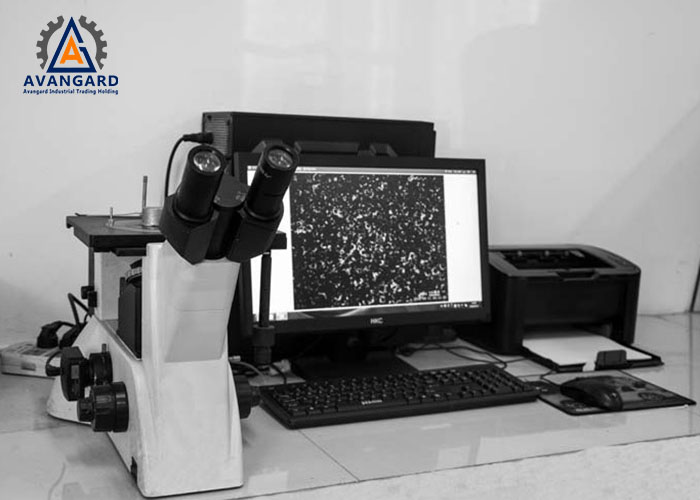
Metallography of cast iron is a specialized process used for analyzing and evaluating the final microstructure of various types of cast iron. As one of the most important methods for quality control and microstructural assessment of materials, this technique allows precise observation and identification of phases, graphite forms, and the metallic matrix using an optical microscope.
The primary goal of metallography in cast irons is to determine the type of microstructure and its correlation with the mechanical properties and performance of the alloy. Given the critical importance of this method in metallurgical investigations, Avangard Industrial Trading Holding provides a comprehensive analysis of cast iron metallography and its applications across different industries.
Preparation Stages and Metallographic Procedure of Cast Iron in Avangard Laboratory
Before performing metallography and observing the microstructure of cast iron under an optical microscope, the specimen must undergo a series of precise preparation steps. These stages are carefully designed to ensure that the metallic structure remains unchanged, so the examination results are accurate and reliable.
- Sample Cutting: In the first step, the specimen is carefully sectioned so that a suitable portion is selected for observation. The cutting process must be carried out in a way that prevents any thermal or mechanical alteration of the metal’s structure.
- Coarse Grinding: At this stage, the surface of the sample is roughly ground to remove initial irregularities and prepare it for finer grinding stages.
- Mounting: To facilitate handling, holding, and precise polishing, the sample is embedded in a special resin or plastic mounting material. This process provides greater control during polishing and microscopic observation.
- Fine Grinding: The surface is gradually smoothed to eliminate even the smallest irregularities or scratches remaining from previous grinding steps, revealing the true structure of the metal.
- Final Polishing: Polishing is performed using special cloths or polishing pastes to remove all remaining scratches and obtain a mirror-like, uniform surface.
- Etching: To reveal grain boundaries and fine structural details, the specimen is chemically etched with a suitable etchant under controlled conditions. This step plays a crucial role in enhancing image clarity under the microscope.
Finally, using an optical microscope at various magnifications, detailed metallographic images of the cast iron are captured and analyzed. These data enable Avangard’s specialists to accurately evaluate the microstructure and final quality of the alloy.
Microstructural Analysis of Cast Iron and Graphite Types in Industrial Metallography
In metallographic studies of cast iron, two hypothetical extreme cases can be considered regarding the distribution of carbon within the microstructure:
- All carbon exists as free graphite: In this case, the final microstructure consists mainly of ferrite and graphite. The resulting cast iron exhibits a softer and more ductile structure.
- All carbon exists in a combined form: Consequently, the microstructure is composed of pearlite and cementite (Fe₃C), leading to higher hardness and brittleness.
In practice, neither of these two extreme conditions is fully realized. The actual microstructure of cast irons usually lies between these two theoretical limits.
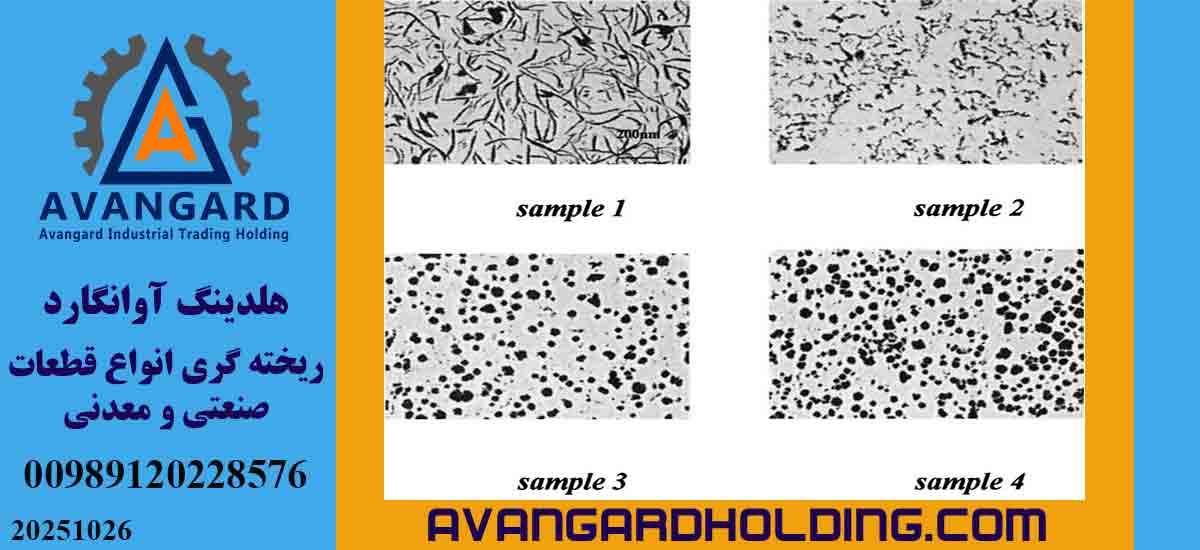
In metallography, graphite in cast iron can appear in three primary morphologies:
- Flake Graphite
- Irregular (Underdeveloped Nodular) Graphite
- Spheroidal Graphite
Each form of graphite has a significant influence on the mechanical properties and overall performance of the alloy. For instance, the presence of spheroidal graphite improves toughness and impact resistance, while flake graphite increases brittleness and reduces ductility.
It is important to note that the density of cast iron is not constant; it depends on factors such as chemical composition, carbon content, and the presence of alloying elements. These variables directly affect the microstructure and the results obtained from metallographic analysis.
For a deeper understanding of these principles, you can also refer to Avangard’s specialized article: “What Is Casting?”, available in the company’s technical blog.
In cast iron metallography, the morphology of graphite plays a decisive role in determining the final properties of the alloy. Depending on solidification conditions and chemical composition, graphite can take different shapes within the metallic matrix. The following table summarizes and compares the main types of graphite in cast iron along with their corresponding characteristics:
| Graphite Type | Appearance in Metallography | Typical Matrix Structure | Mechanical Characteristics | Common Applications |
| Flake Graphite | Flaky and irregular | Ferritic or pearlitic | High compressive strength, high brittleness | Grey cast iron, engine components |
| Irregular (Snowflake) Graphite | Irregular and intermediate | Pearlitic–ferritic | Balanced combination of hardness and ductility | Semi-ductile cast iron, general-purpose parts |
| Spheroidal Graphite | Spherical and uniform | Ferritic or pearlitic | High toughness and tensile strength | Ductile (nodular) cast iron, pipes, gears |
Microstructure and Metallographic Characteristics of Grey Cast Iron
In the metallography of grey cast iron, graphite appears as free flakes or thin lamellae (flake graphite) distributed throughout the metallic matrix. This specific graphite morphology causes fracture surfaces to exhibit a grey appearance—hence the name grey cast iron.
The metallic matrix of grey cast iron can vary depending on the solidification conditions and chemical composition. It may be ferritic, pearlitic, or a combination of both. A ferritic matrix results in a softer alloy with improved machinability, whereas a pearlitic matrix provides higher hardness and superior wear resistance.
In metallographic images of grey cast iron, graphite typically appears as dark flakes embedded within a lighter metallic background. The shape and distribution of these graphite flakes serve as key indicators in assessing the quality and classification of the cast iron.
The following table presents a comparison of different matrix conditions in grey cast iron:
| Matrix Type | Metallographic Structure | Main Mechanical Characteristics | Typical Applications |
| Ferritic | Flake graphite dispersed in a soft ferritic matrix | High ductility, excellent machinability | Engine blocks, pump housings |
| Pearlitic | Flake graphite embedded in a pearlitic matrix | High hardness, superior wear resistance | Brake discs, gears |
| Ferritic–Pearlitic | Combination of both matrices with flake graphite | Balanced strength and ductility | General machine components |
Metallographic Examination of White Cast Iron and Its Pearlite–Ledeburite Structure
In white cast iron, unlike grey cast iron, carbon does not exist as free graphite. Instead, it is entirely combined with iron to form iron carbide (cementite – Fe₃C). This characteristic results in a crystalline, bright white fracture surface, giving the material its name — white cast iron.
The metallographic microstructure of white cast iron typically consists of a pearlitic or ledeburitic matrix. Within this structure, the cementite phase appears as white bands or network-like regions distributed among dendritic branches. The extensive presence of iron carbide imparts very high hardness but also significant brittleness to the alloy.
Under microscopic examination, the bright regions correspond to cementite, while the darker areas represent the pearlitic matrix. This distinct contrast is one of the most recognizable metallographic features of white cast iron compared with other cast iron types.
The following table summarizes the key differences between white and grey cast irons:
| Property | White Cast Iron | Grey Cast Iron |
| Form of Carbon | Combined form (cementite) | Free graphite |
| Fracture Surface Appearance | Bright white, crystalline | Grey and dull |
| Hardness | Very high | Medium to low |
| Toughness (Ductility) | Low | Relatively high |
| Machinability | Very poor | Excellent |
| Common Applications | Mill liners, wear-resistant components | Engine parts, pump housings |
In general, white cast iron is best suited for applications where high hardness and superior wear resistance are the primary requirements. At Avangard Industrial Trading Holding, metallography is employed to precisely identify the pearlitic–ledeburitic structure of white cast iron and to evaluate the final quality of manufactured components.
Metallography of Malleable Cast Iron and Analysis of Graphite Morphology and Matrix Structures
In malleable cast iron, graphite appears in spheroidal or irregular nodular forms within the metallic matrix. This type of cast iron is initially produced as white cast iron (or a chemically equivalent composition) and subsequently undergoes an annealing process. During annealing, graphite precipitates and grows from cementite (Fe₃C), forming rounded or irregular shapes. This transformation significantly enhances the toughness and ductility of malleable cast iron compared with white cast iron.
In the metallographic analysis of malleable cast iron, besides the spheroidal or irregular graphite particles, three primary matrix types can be distinguished:
- Black Heart: The structure is uniformly ferritic from surface to core, with minor pearlitic regions in some cases.
- White Heart: Contains a higher carbon content and lower silicon content than the black heart type. The matrix can be fully ferritic or a ferritic–pearlitic combination.
- Pearlitic Matrix: This matrix forms in layered or nodular patterns, providing greater hardness than the ferritic structure.
Table – Microstructural Analysis of Malleable Cast Iron:
| Matrix Type | Metallographic Characteristics | Carbon and Silicon Content | Mechanical Properties | Common Applications |
| Black Heart | Uniform ferritic matrix | Lower carbon, medium silicon | Good softness and ductility | Light machinery parts, internal components |
| White Heart | Ferritic or ferritic–pearlitic matrix | Higher carbon, lower silicon | Balanced hardness and ductility | Medium-load bearing parts, general cast components |
| Pearlitic | Layered or nodular pearlitic matrix | Moderate carbon, low silicon | High hardness and wear resistance | Wear-resistant parts, gears, and special industrial components |
In summary, malleable cast iron, with its unique combination of spheroidal graphite and varying matrix structures, offers a wide range of mechanical properties. At Avangard, metallographic analysis of malleable cast iron is employed to ensure Casting Quality Control and to select the optimal alloy composition for various casting applications.
Metallography of Ductile Cast Iron and Analysis of Spheroidal Graphite Microstructure
In the metallography of ductile cast iron (nodular cast iron), graphite appears in a spheroidal form within the metallic matrix. This type of cast iron, also known as nodular or spheroidal graphite cast iron, provides a combination of high hardness and desirable ductility.
The metallic matrix of ductile cast iron can be ferritic, pearlitic, or a ferritic–pearlitic combination. This matrix variation results in diverse mechanical properties, making ductile cast iron not only wear-resistant but also possessing high tensile strength, adequate hardness, and significant ductility.
These properties make ductile cast iron an ideal choice for applications requiring strong, tough, and durable components.
Table – Microstructural Analysis and Characteristics of Ductile Cast Iron:
| Matrix Type | Metallographic Characteristics | Mechanical Properties | Common Applications |
| Ferritic | Spheroidal graphite in a soft ferritic matrix | High ductility, medium hardness | Low-load industrial parts, pump housings |
| Pearlitic | Spheroidal graphite in a hard pearlitic matrix | High hardness and wear resistance | Gears, load-bearing components |
| Ferritic–Pearlitic | Combination of both matrices with spheroidal graphite | Balanced hardness and ductility | Axles, shafts, automotive components |
Through precise metallographic analysis of ductile cast iron, Avangard’s specialists are able to determine the most suitable alloy composition for specific industrial applications, thereby optimizing the quality of cast components.
Final Remarks on Cast Iron Metallography and Its Importance in Alloy Quality
Metallography of cast iron is a key tool for examining the microstructure of various iron-based alloys, enabling experts to accurately assess the properties and quality of cast components. The microstructure and metallographic results of grey, white, ductile, and malleable cast irons differ significantly, with each type playing a crucial role in determining the mechanical properties and final application of the alloy.
At Avangard Industrial Trading Holding, leveraging modern knowledge and the expertise of our foundry specialists, we strive to deliver the highest quality in cast iron foundry services. For more information or professional consultation, you can contact our experts through the link provided on our website.
🏢 Avangard Industrial Trading Holding Company – A pioneer in supplying and manufacturing casting parts in the Middle East 🌍 📞 Phone: +98 912 022 8576 🌐 Website: En.Avangardholding.com


