 فارسی
فارسی  Arabic
  Russian


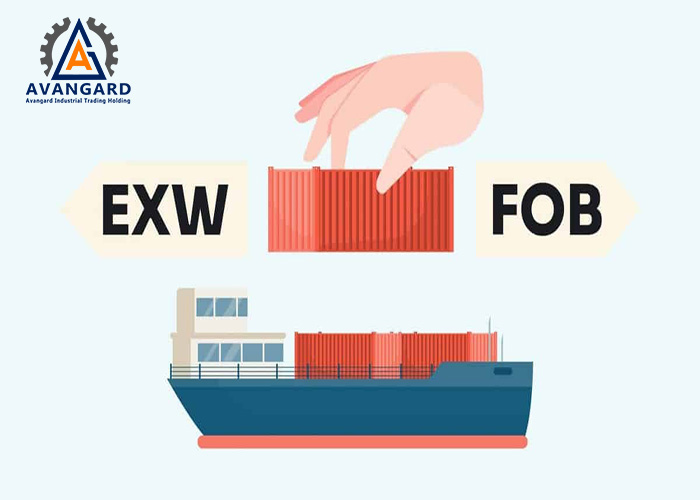
In the field of exporting industrial components, understanding the concepts of FOB and EXW pricing is essential, as these terms can significantly impact the final cost, delivery time, and contractual responsibilities. Companies such as Avangard Industrial Trading Holding, which specialize in casting crusher parts and Production of Mining Equipment and Crushing Lines, must clearly understand the difference between these two terms when cooperating with international clients.
When exporting products such as crusher hammers, jaw plates, side plates, toggle plates, conveyor drums, rollers, and roller brackets, choosing between FOB or EXW pricing determines how far the seller’s responsibility extends and from which point the costs and risks are transferred to the buyer.
Meaning of FOB in the Export of Casting Parts
The term FOB (Free On Board) means “delivery on board the vessel at the port of shipment.” Under FOB terms, the seller — for example, Avangard — is responsible for transporting the goods to the port of origin, completing export customs procedures, and loading the goods onto the vessel. Once the cargo is placed on board, all costs and responsibilities are transferred to the foreign buyer.
For instance, if Avangard exports a shipment of manganese steel crusher casting parts under FOB Bandar Abbas, the company is responsible for customs clearance and loading the goods onto the vessel; however, the cost of ocean freight and insurance falls entirely on the buyer.
| Contract Type | Delivery Location | Cost Responsibility Up to Port | Cost Responsibility After Port | Risk Transfer Point |
| FOB (Free On Board) | Port of origin (on board the vessel) | Seller | Buyer | Upon loading the goods onto the vessel |
The FOB method is generally suitable for companies that have export experience as well as proper packaging and transportation capabilities up to the port. Since Avangard specializes in heavy industrial crusher equipment and high-grade casting parts, this method is considered ideal due to the company’s ability to ensure secure packaging and reliable handling of the goods prior to shipment.
Meaning of EXW and Its Difference from FOB
The term EXW (Ex Works) means “delivery at the seller’s factory or production facility.” Under EXW terms, the seller is only responsible for making the goods available at the place of production. From that point onward, all costs—including transportation, insurance, customs procedures, export clearance, and delivery to the final destination—are entirely the responsibility of the buyer.
For example, if a foreign customer intends to purchase crusher casting parts from Avangard under EXW terms, the goods will be delivered at the factory door, and the buyer must handle the entire process of loading, transportation, customs clearance, and export procedures.
| Contract Type | Delivery Location | Cost Responsibility to Destination | Customs and Insurance Responsibility | Risk Transfer Point |
| EXW (Ex Works) | Factory gate | Buyer | Buyer | Immediately upon delivery at the factory |
In fact, EXW represents the simplest form of delivery from the seller’s perspective, but it requires more logistical coordination on the buyer’s side.
Which Method is Better for Exporting Crusher Equipment?
Choosing between FOB and EXW depends on several key factors:
- The seller’s experience in customs procedures and export operations.
- The location of the buyer and the transportation route.
- The type of goods and their sensitivity during transit.
For companies like Avangard, which specialize in the production and casting of crusher parts and crushing equipment, FOB is generally a more practical choice because it allows greater control over loading quality, industrial packaging, and delivery at the port.
However, if the buyer has a logistics representative in Iran and prefers to handle transportation independently, EXW can also be used as an alternative.
Key Points in Export Contracts
When preparing export contracts for industrial components, it is essential to clearly specify the following details:
- The type of delivery: FOB or EXW
- The exact port or delivery location
- The type of components (e.g., crusher parts, steel or cast iron casting parts)
- The net and gross weight of the goods
- The method of insurance and customs clearance at the destination
Including these details ensures contract transparency and helps prevent commercial disputes.
Conclusion
In the export of casting crusher parts and crusher equipment, the difference between FOB and EXW pricing plays a decisive role in the final cost and the responsibilities of both parties. FOB is generally a safer and more professional choice for manufacturing and industrial companies like Avangard, which specialize in producing and supplying mining equipment and crusher machinery.
Choosing the right method not only optimizes export costs but also builds trust with international clients and facilitates the expansion of global markets.
🏢 Avangard Industrial Trading Holding Company – A pioneer in supplying and manufacturing casting parts in the Middle East 🌍 📞 Phone: +98 912 022 8576 🌐 Website: En.Avangardholding.com


