 فارسی
فارسی  Arabic
  Russian



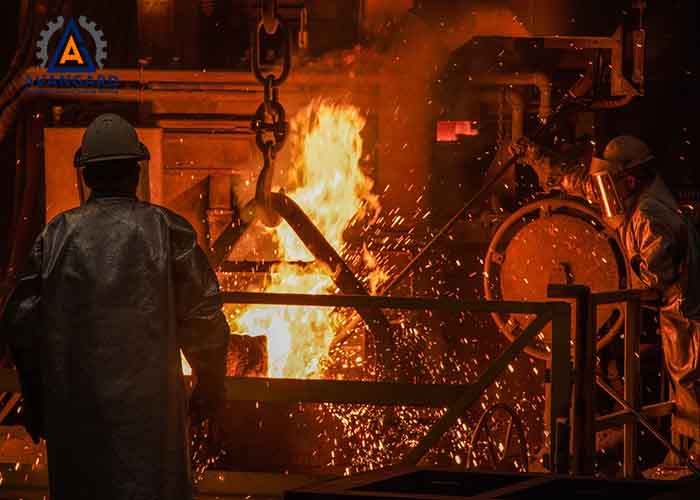
Steel, as one of the most widely used metals across various industries, plays a vital role in engineering, construction, and the manufacturing of industrial equipment — particularly in crusher machinery, mining, and road construction)Crushers and Road Construction ( equipment.
One of the key parameters in technical design and engineering calculations is the density (or specific weight) of steel, which has a direct impact on the overall weight and structural strength of components.
Understanding the density of carbon steel, cast iron, and stainless steel alloys is especially important due to their extensive application in mechanical and industrial fields.
Knowledge of steel density and other commonly used alloys enables engineers and designers to accurately calculate the weight of metal structures, allowing them to design systems that are lighter, stronger, and more cost-efficient.
Typically, the density of steel is estimated to range between 7,750 and 8,050 kilograms per cubic meter (kg/m³).
In this article, we will discuss the density of steel, methods for calculating the specific weight of different types of steel, and the significance of these properties in the design of industrial and structural components, providing practical and precise information for engineers, manufacturers, and equipment designers.
Difference Between Specific Weight and Density of Metals
Many people mistakenly consider the specific weight of metals to be the same as their density, but these two terms have distinct meanings in engineering.
Specific weight refers to the ratio of an object’s weight to its volume, while density is the ratio of mass to volume — meaning it is independent of gravity and does not directly represent weight.
In fact, the main difference is that specific weight is related to the force of gravity (weight force), whereas density only expresses the amount of matter contained in a given volume.
Recognizing this distinction is essential in engineering design and structural calculations, ensuring that weight estimations and load-bearing analyses are both accurate and scientifically reliable.
Steel and Its Properties
Steel is an alloy of iron and carbon, known for its high strength, flexibility, and significant resistance to wear and corrosion.
It is one of the most widely used metals in the world, with a history that dates back to ancient times when it was utilized for tools, weapons, and military equipment.
Today, steel plays a fundamental role in a wide range of industries, including construction, automotive manufacturing, home appliance production, and heavy industry.
The diversity of grades and alloy compositions makes steel an ideal material for various industrial and structural applications.
For further technical insight, you can also refer to our related article:
“What Are Steel Casting Services?” — available on the Avangard Holding website.
What Is the Density of Steel?
To calculate the density of steel, its mass is divided by its volume.
Determining the volume of steel components with complex geometries—such as cast or machined parts—can be challenging. However, by knowing the density of steel and measuring the mass of the part, the volume can easily be determined.
The density of steel varies depending on its chemical composition and alloying elements, but in general, it ranges between 7,750 and 8,050 kilograms per cubic meter (kg/m³).
Is Steel Denser Than Iron?
Steel is an alloy of iron and carbon, typically containing between 0.2% and 2.1% carbon.
This carbon content significantly influences the mechanical properties of steel — such as strength, hardness, and ductility.
Compared to pure iron, steel exhibits higher tensile strength and hardness, while also maintaining excellent formability, making it suitable for the manufacturing of diverse industrial components and structural parts.
Steel does not occur naturally; it is produced by refining iron ore and adding controlled amounts of carbon and alloying elements.
Its density generally falls between 7,750 and 8,050 kg/m³, which is slightly higher than that of iron (7,860 kg/m³).
Specific Weight of Steel Types and Their Importance in Construction
Due to its versatility and wide range of applications, steel is available in many product forms such as I-beams, angles, rebars, sheets, and plates — each manufactured according to specific industrial standards and with its own specific weight.
The specific weight of steel plays a crucial role in determining the strength, stability, and overall quality of structures, making it an essential factor in both engineering design and construction.
Avangard Holding, as a specialized reference in the field of iron and steel, provides a comprehensive table of specific weights for different steel grades, helping engineers and designers choose materials that best suit their technical requirements.
Moreover, through the production and casting of high-quality steel components in our advanced foundries, and in compliance with international standards, Avangard ensures the realization of safe, durable, and reliable industrial and construction projects.
Specific Weight of Different Types of Steel
The specific weight of steel is one of the most important parameters in engineering design and structural analysis, as it directly affects the strength, resistance, and overall weight of constructions and mechanical components.
Below is an overview of the specific weight of various types of steel, categorized based on their composition and industrial application.
| Type of Steel | Group / Series | Specific Weight (g/cm³) |
| Carbon Steel | Low Carbon Steel | 7.85 |
| Medium Carbon Steel | 7.85 | |
| High Carbon Steel | 7.85 | |
| Stainless Steel | Series 300 | 8 |
| Series 400 | 7.75 | |
| Alloy Steel | Chromium–Molybdenum Steel | 7.8 |
| Nickel–Chromium Steel | 7.85 | |
| Tool Steel | Cold Work Tool Steel | 7.70 – 7.85 |
| Hot Work Tool Steel | 7.75 – 8.00 | |
| High-Speed Tool Steel | 8.00 – 8.20 |
These data help engineers, manufacturers, and builders make accurate decisions when selecting the appropriate type of steel based on specific project requirements, ensuring maximum safety, strength, and quality of structures and components.
Avangard Holding, by providing high-quality steel products manufactured in compliance with international standards, makes this selection process simpler, more reliable, and technically optimized for every industrial application.
Factors Affecting the Specific Weight of Steel
The specific weight of steel depends on several parameters and may vary under different environmental and metallurgical conditions:
- Gravitational Acceleration:
The specific weight of steel can increase or decrease depending on changes in location and gravitational acceleration. This factor is particularly important in precise engineering calculations, especially in aerospace and structural applications. - Ambient Temperature:
Temperature is one of the key factors influencing the specific weight and density of metals. As temperature rises or falls, the volume and mass distribution of steel change accordingly, resulting in variations in its specific weight. - Environmental Pressure:
Pressure can also affect the specific weight of steel, although its impact is generally minimal compared to temperature and gravity. It is mainly considered in high-pressure industrial or geotechnical environments. - Microstructure and Alloy Composition:
The microstructure and alloying elements of steel are among the most significant determinants of its specific weight.
To identify and analyze the microstructure, engineers perform a metallographic examination, which provides detailed information about the internal grain structure, phase distribution, and mechanical properties of steel.
Conclusion
Understanding the specific weight and density of steel plays a crucial role in determining the final quality and performance of cast components.
However, due to the wide variation in alloy compositions, accurately calculating these parameters requires specialized knowledge and technical expertise.
Avangard Holding, with its team of experienced metallurgical engineers and casting specialists, is fully equipped to provide precise and professional services in this field.
By accurately determining the specific weight and density of your desired alloy, we ensure an optimized casting process that delivers exceptional quality and durability.
Manufacturers and industrial clients can easily submit their casting orders through our Foundry Workshop page and benefit from Avangard’s professional engineering services and compliance with international quality standards.
🏢 Avangard Industrial Trading Holding Company – A pioneer in supplying and manufacturing casting parts in the Middle East 🌍
📞 Phone: +98 912 022 8576
🌐 Website: En.Avangardholding.com


