فارسی
فارسی  العربية
  Русский
  Azərbaycan

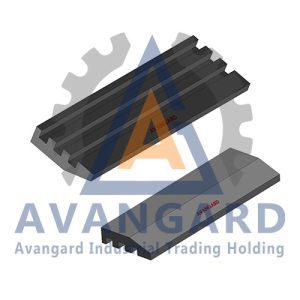
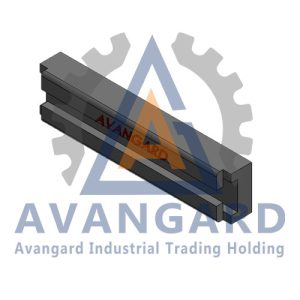
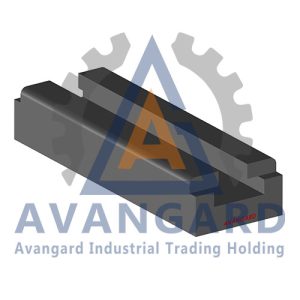
Phosphor bronze, also known as tin bronze, is a group of copper-based alloys consisting primarily of copper, tin, and phosphorus. This alloy typically contains between 0.5% to 11% tin and 0.01% to 0.35% phosphorus. The addition of tin enhances the alloy’s corrosion resistance, while phosphorus contributes to increased surface hardness and improved wear resistance.
The most notable properties of phosphor bronze include excellent spring characteristics, high fatigue resistance, good ductility, ease of soldering, and strong resistance to corrosive environments. Owing to these features, components made from this alloy are widely used in electronic industries and applications exposed to corrosive conditions. Phosphor bronze alloys are categorized under the UNS standards ranging from C50100 to C54200.
When lead is added to this composition, mechanical strength and fatigue resistance are further improved, while machinability becomes easier. This modified version of the alloy also exhibits superior wear and corrosion resistance, making it suitable for manufacturing bearings, washers, and cams, which are standardized under UNS C53400 to C54400.
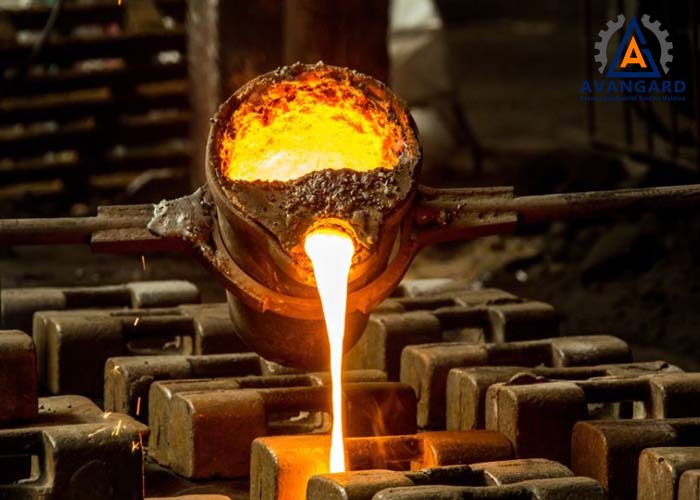
The importance of this alloy in various industries—especially in the production of critical components—is undeniable. One of the primary methods for producing phosphor bronze parts is casting. In this process, the molten alloy is poured into a specialized mold, and after cooling and solidification, the final component takes shape. Casting allows for the production of complex geometries with precise technical specifications, making it one of the fundamental processes in component manufacturing.
For more in-depth technical insights into the phosphor bronze casting process, you can refer to the related article on Avangard titled “What Is Casting?”, which comprehensively covers the technical aspects and detailed stages of this process.
Physical Properties and Characteristics of Phosphor Bronze Alloy
Due to its unique composition and exceptional mechanical strength, phosphor bronze is considered one of the most advanced industrial alloys. This material is particularly valued for manufacturing high-performance and precision components. The main physical properties of phosphor bronze include:
- High fatigue and fracture resistance: This property makes the alloy ideal for components subjected to continuous mechanical stress. • Excellent resistance to moisture and corrosion: Phosphor bronze demonstrates superior durability in corrosive environments. • High electrical conductivity: This characteristic allows its use in electrical and electronic applications as a conductive material. • High elasticity and fine-grained structure: The alloy’s uniform and fine grain structure enhances its mechanical strength and flexibility. • Low coefficient of friction: This property is essential for components such as bearings and washers that are in constant contact with other parts.
In addition, the high fluidity of the molten alloy is one of the most significant advantages of phosphor bronze, as it facilitates the casting process. This property enables the production of complex and precise components with minimal material waste.
The chemical composition of phosphor bronze alloys not only defines their mechanical and physical properties but also influences their casting behavior and formability. Below is a table showing the typical elemental composition (by weight percentage) of alloy C51000:
| Element | Weight Percentage (%) |
| Phosphorus (P) | 0.03 – 0.35 |
| Nickel (Ni) | Not Applicable (N/A) |
| Iron (Fe) | 0.1 |
| Zinc (Zn) | 0.3 |
| Lead (Pb) | 0.05 |
| Copper (Cu) | Balance |
This precise combination of elements gives the C51000 phosphor bronze alloy its high mechanical strength, excellent castability, and long service life in corrosive environments. Accurate control over the percentage of each element not only affects the physical and mechanical properties of the alloy but also influences its formability and molten fluidity during the casting process.
Chemical Composition of Phosphor Bronze Alloy C54400 (Weight Percentage):
| Element | Weight Percentage (%) |
| Phosphorus (P) | 0.01 – 0.50 |
| Nickel (Ni) | 0.1 |
| Iron (Fe) | 1.50 – 4.50 |
| Zinc (Zn) | 3.00 – 4.00 |
| Lead (Pb) | 3.50 – 4.50 |
| Copper (Cu) | Balance |
Typical Chemical Composition of High-Tin Phosphor Bronze Alloy (Weight Percentage)
| Element | Weight Percentage (%) |
| Silicon (Si) | 0.005 |
| Manganese (Mn) | Not Applicable (N/A) |
| Aluminum (Al) | 0.005 |
| Sulfur (S) | 0.05 |
| Phosphorus (P) | 1.5 |
| Antimony (Sb) | 0.2 |
| Nickel (Ni) | 1 |
| Iron (Fe) | 0.2 |
| Zinc (Zn) | 3.00 – 5.00 |
| Lead (Pb) | 0.3 |
| Tin (Sn) | 7.50 – 9.00 |
| Copper (Cu) | 86.00 – 89.00 |
Casting Process of Phosphor Bronze Alloy
The casting of phosphor bronze is one of the key methods for producing durable and high-quality industrial components. This process involves several specialized stages, each playing a crucial role in achieving the desired mechanical and physical properties of the final product. The main stages of the phosphor bronze casting process are as follows:
- Alloy Preparation Phosphor bronze is produced by combining copper, tin, and phosphorus. The proportion of these elements varies depending on the component’s requirements and technical specifications, typically containing 0.5–11% tin and 0.01–0.35% phosphorus. This composition enhances corrosion and wear resistance, surface hardness, and provides excellent spring characteristics to the alloy.
- Melting the Alloy The alloy is melted in specialized furnaces until it reaches a fully molten state. Precise temperature control and environmental conditions are critical at this stage, as the quality of the molten metal directly affects the mechanical properties of the final casting.
- Molding The prepared molten alloy is poured into specific molds. Depending on the casting method and part geometry, molds can be made from sand, permanent metals, or other refractory materials. The choice of mold material determines the dimensional accuracy and surface quality of the finished product.
- Cooling After pouring, the casting must cool gradually to solidify. The cooling rate and conditions have a direct impact on the microstructure and mechanical properties of the part and must be carefully controlled.
- Mold Removal Sand molds: Once the casting has completely cooled, the sand mold is broken to release the part. • Permanent molds: The metal mold is opened and the casting is carefully removed.
- Surface Finishing Cleaning: Any remaining sand, oxides, or residues are removed from the surface. • Machining: If necessary, the casting undergoes machining to achieve precise dimensions and specifications. • Polishing and final finishing: Depending on the application, the surface may be polished and refined to achieve a smooth, defect-free finish.
This precise and specialized process results in high-quality castings with excellent mechanical strength and long service life, underscoring its vital importance across various industrial sectors.
Casting Methods of Phosphor Bronze Alloy
The casting of phosphor bronze can be performed through various methods depending on the type of component and industrial requirements. Owing to its high fluidity in the molten state, this alloy allows for the easy molding and production of complex shapes. The most common casting methods for phosphor bronze are described below:
- Sand Casting Sand casting is one of the most common and cost-effective techniques for producing phosphor bronze components, accounting for approximately 60% of industrial castings. The sand mold is typically made from a mixture of sand and clay, which provides both strength and plasticity. These molds are placed inside boxes called flasks, featuring special cavities and gating systems to compact the sand and direct the molten alloy.
The initial pattern is often produced using 3D printing technology, allowing the intricate details of the final part to be accurately replicated. Once the mold is prepared, the molten alloy is poured into the mold cavity, and gases or vapors generated during the process are released through special vents to prevent casting defects. After gradual cooling, the sand mold is broken using specific tools, and the finished casting is removed. This method enables the production of detailed components with lower production costs.
- Permanent Mold Casting In this method, molten phosphor bronze is poured into permanent and reusable molds. These molds are usually made from gray cast iron, which provides excellent resistance to heat, corrosion, and fatigue. Filling of the mold is typically done by gravity, although pressure casting or vacuum-assisted techniques can also be applied.
The advantages of permanent mold casting include: • Production of components with precise dimensions and superior surface finish • Capability to produce small parts with fine details • High production rate and consistency
This technique is suitable for manufacturing parts that require a high-quality surface finish and long service life, making it widely used across multiple industrial sectors.
- Chill Casting (Cold Casting) Chill casting is an advanced subcategory of mold casting, designed to accelerate the cooling rate of molten phosphor bronze. This method is particularly effective when the solidification rate across the part is uneven—typically due to variations in wall thickness or complex geometries of the mold.
In this technique, chilling inserts or cooling elements are placed inside the mold to increase the solidification rate of the alloy. These inserts absorb the heat from the molten metal during cooling, ensuring uniform solidification throughout the part.
Alternatively, cooling elements can be positioned outside the mold, allowing the alloy to bond to the mold surface and become part of the final structure. The use of chill casting enhances structural integrity, reduces internal stresses, and improves dimensional accuracy. It is particularly effective for producing components with complex shapes and variable thicknesses.
Industrial and Consumer Applications of Phosphor Bronze Alloy
Due to its unique combination of copper, tin, and phosphorus, phosphor bronze is widely used in both heavy industries and the production of consumer and decorative goods. Its superior corrosion resistance, wear resistance, fatigue strength, excellent ductility, and outstanding spring properties make it a top choice among engineers and industrial designers.
Industrial Applications
In electrical and electronic industries, phosphor bronze is highly valued for its excellent electrical conductivity and exceptional mechanical durability. One of the most notable historical examples of its industrial application was in the manufacture of memory plates for the UNIVAC I computer—the world’s first general-purpose digital computer.
These memory plates were made from nickel-plated phosphor bronze alloy, measuring 12.7 mm in thickness, and had a data storage capacity of 128 characters per inch with a data transfer rate of 7,200 characters per second, enabling efficient system performance at the time.
Applications of Cast Phosphor Bronze
Some of the key applications of this alloy in cast components include:
- Relay and circuit breaker contacts, due to high strength and adequate electrical conductivity • Fuse clips and PCB connectors, which require excellent mechanical durability • Springs and wires designed to withstand low to medium mechanical loads • Acoustic guitar strings and musical instrument components, such as saxophone parts • Special cylinders for the storage and disposal of nuclear waste, using CuOFP alloy, which offers extremely high oxidation resistance
Thanks to phosphor bronze’s exceptional fatigue resistance, components produced from this alloy exhibit long service life, operating efficiently for many years without performance degradation. In addition to durability, the attractive appearance and excellent surface finish of cast products increase their popularity in consumer and decorative applications.
Phosphor Bronze Casting at Avangard
Phosphor bronze casting is one of the complex and critical processes in producing durable, high-quality industrial components. This process includes alloy preparation, melting, molding, cooling, mold removal, surface finishing, and quality control, each of which plays a crucial role in ensuring the mechanical and physical properties of the final product.
Phosphor bronze casting can be carried out using various methods, including: • Sand casting • Permanent mold casting • Chill casting
Each of these methods has its own advantages and specific applications, and the appropriate choice depends on the type of component, production volume, and technical requirements.
At Avangard, our online casting order system allows you to conveniently place orders for phosphor bronze components and benefit from our professional services. To submit an order and view further details, simply visit the Avangard website and complete your order online.
🏢 Avangard Industrial Trading Holding Company – A pioneer in supplying and manufacturing casting parts in the Middle East 🌍 📞 Phone: +98 912 022 8576 🌐 Website: En.Avangardholding.com