فارسی
فارسی  العربية
  Русский
  Azərbaycan




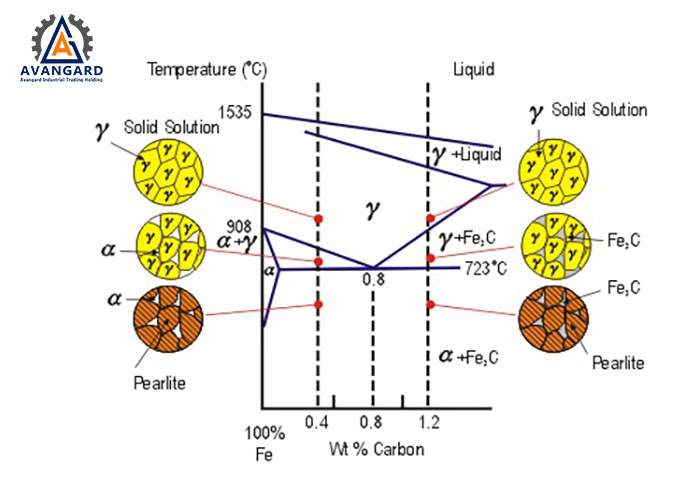
Metallography is the science of studying the physical structure and components of metals, commonly referred to as the microstructure of metals. It is one of the most important tools for metallurgical engineers to analyze the properties of metals. Metallographic examinations are typically conducted using optical microscopes or electron microscopes, providing precise information about equilibrium and non-equilibrium phases, the manufacturing methods and treatments applied to a component, as well as quantitative parameters such as grain size or the amount of inclusions present in an alloy.
In this process, the metal surface is initially prepared using techniques such as grinding, sanding, polishing, and etching. After proper preparation, the sample is analyzed under a microscope. These analyses help engineers accurately evaluate the quality and performance of steel.
One of the most critical factors determining the properties of steel is its carbon content. Carbon steels, which are iron-carbon alloys, account for over 98% of all produced iron alloys due to their wide range of properties and versatility.
If you are active in the steel industry and seeking high-quality steel components from a modern and fully equipped workshop, we recommend visiting our “What is Casting?” page. This page provides comprehensive information about steel casting prices, the services offered, and ordering conditions at Avangard Holding.
Steel Microstructure and Its Impact on Physical and Chemical Properties
The internal structure of a material, also known as its microstructure, plays a decisive role in all of its physical and chemical properties. Stainless steel differs from other types of steel in this regard, as it contains alloying elements such as nickel, chromium, and other additives. This specific composition gives stainless steel exceptionally high resistance to corrosion and harsh environmental conditions.
Due to its outstanding mechanical properties and relatively low cost, steel has always been one of the most widely used and essential metals across various industries. The mechanical performance of steel is highly dependent on its microstructure; the distribution, shape, and size of the phases within the microstructure determine how the material behaves under operational conditions. Depending on the casting method and heat treatment applied, the microstructure of steel can include phases such as ferrite, cementite, austenite, pearlite, and martensite.
In the following sections, we will examine steel from a metallographic perspective and provide a detailed technical explanation of each of these phases and microstructures.

Ferrite: One of the Key Microstructures in Steel
Ferrite is one of the primary microstructures in ferritic steels and plays a significant role in steel metallography. This structure, also known as alpha iron (α-Fe), is a solid solution with iron as the main element and a body-centered cubic (BCC) crystal structure. Ferritic steels typically contain less than 0.10% carbon and have a chromium content exceeding 12%.
The grain structure and chemical composition of ferritic stainless steel differ from other types of stainless steel. These steels are defined as a class of chromium-based stainless alloys and are inherently non-hardenable by heat treatment. Their hardness can only be increased through cold working.
The typical composition range for these steels is as follows:
- Chromium: 10.5% to 30%
- Carbon: less than 0.06%
Some of the most important ferritic stainless steel grades include:
- Stainless Steel 409
- Stainless Steel 430
- Stainless Steel 430LI
- Stainless Steel 434
- Stainless Steel 439
- Stainless Steel 442
- Stainless Steel 444
- Stainless Steel 446
Due to their excellent corrosion resistance and structural stability, these steels are widely used across various industries, including automotive, Oil & Gas Industry, kitchen equipment, and industrial components.
Cementite: Iron Carbide and Its Role in Steel Microstructure
In most iron-carbon alloys, carbon primarily exists in the form of iron carbide (Fe₃C), also known as cementite. Cementite is a key component of the microstructure of steel and iron, and due to its high carbon content, even small variations in the carbon content of iron can cause significant changes in the cementite concentration.
During melting and casting processes, cementite is soluble in molten iron. This is one of the reasons carbon tends to accumulate in the product obtained from blast furnaces during iron ore reduction. This characteristic is somewhat advantageous because the melting point of the iron-cementite mixture drops to approximately 1100°C, allowing the product to accumulate at the base of the furnace at temperatures lower than 1535°C.
Cementite has an orthorhombic crystal structure and is considered a hard and brittle material. Consequently, in steel and iron metallography, cementite is generally recognized as a hard ceramic-like phase and plays a significant role in determining the mechanical and structural properties of steel.
Austenite: A Low-Strength Steel Microstructure
Austenite is one of the important microstructures of steel and has a face-centered cubic (FCC) crystal structure. This phase forms in the iron-carbon (Fe-C) system above the eutectoid temperature of 723°C. The eutectoid temperature is the minimum temperature at which a material exists as a single solid solution phase, allowing alloying elements to fully dissolve in the matrix.
In austenite, alloying elements occupy interstitial or substitutional positions in the FCC iron lattice depending on their atomic size and valence. If austenite is slowly cooled below 723°C, it becomes unstable and undergoes an allotropic transformation into ferrite and cementite (α-Fe + Fe₃C). However, adding elements such as nickel and manganese can stabilize the austenite phase down to room temperature, whereas elements like silicon, molybdenum, and chromium tend to destabilize it and raise the eutectoid temperature.
From a microscopic perspective, austenite is often identifiable by its twinning boundaries and can be observed under a reflected-light microscope. Austenite’s ability to incorporate alloying elements into its matrix makes it crucial in determining the mechanical properties of steel.
Some of the mechanical properties of austenite include:
- Low strength
- Low thermal conductivity, although its coefficient of thermal expansion is relatively high
- Increased strength with cold working, which, however, reduces machinability
At approximately 1670°F (910°C), austenite transforms back into ferrite. Ferrite formed at high temperatures is referred to as delta ferrite, while ferrite formed at lower temperatures is known as alpha ferrite, both possessing a structure similar to that of ordinary ferrite.
Pearlite: The Lamellar Microstructure of Stainless Steel
Pearlite is one of the important microstructures in stainless steel, formed as a mixture of ferrite and cementite. In slowly cooled carbon steels, pearlite appears as distinct layers or bands, creating a two-phase structure. In this arrangement, the hard and brittle cementite layers are interleaved with soft and ductile ferrite layers.
The approximate composition of pearlite consists of about 88% ferrite and 12% cementite. Due to its high hardness and strength, this microstructure finds extensive use in various industrial and engineering applications, including:
- Manufacturing cutting tools
- Producing high-strength wires
- Making knives and nails
Pearlite is a lamellar or plate-like structure that forms a repeating network of alpha ferrite and cementite. This microstructure develops only under specific thermal and casting conditions and, due to its layered arrangement, offers high resistance to wear and mechanical pressure.
Moreover, compared to pure iron steels, pearlite is both stronger and lighter, making it suitable for specialized applications. This microstructure is used in producing wires and cables with high mechanical strength, plays a crucial role in certain bridge constructions, and serves as an insulating material in refrigeration technology.
Martensite: The Hardest Steel Microstructure
Martensite is the hardest and most resistant form within the crystalline structure of steel. Depending on the steel’s chemical composition, heat treatment, and aging process, this microstructure exhibits high hardenability and strength. For this reason, martensitic steel has become an ideal choice for manufacturing industrial valves, mechanical tools, turbine components, medical instruments, and other products requiring high hardness and durability.
The typical chemical composition of martensitic steel includes:
- Chromium: 11.5% to 18%
- Carbon: approximately 1.2%
- Nickel: a smaller amount to enhance corrosion resistance
- Other alloying elements such as manganese, nickel, and molybdenum
Due to its high strength, durability, and notable corrosion resistance, martensitic stainless steel is one of the most popular options in various engineering industries for producing critical and widely used components.
Stainless Steel Microstructures
| Microstructure | Approximate Chemical Composition | Characteristics | Applications |
| Ferrite | Chromium 10.5–30%, Carbon <0.06% | Non-hardenable by heat treatment, good corrosion resistance, soft and ductile | Automotive industry, household equipment, industrial components |
| Cementite (Fe₃C) | Carbon 6.69% | Hard and brittle, ceramic-like structure, key role in steel strength | Increases hardness and strength of steel, industrial components, precision tools |
| Austenite | Stabilized by Nickel and Manganese; destabilized by Silicon, Chromium, Molybdenum | Low strength, low thermal conductivity, strength can increase with cold working, FCC phase | Austenitic stainless steels for food processing, medical equipment, pipes, and tanks |
| Pearlite | Ferrite ~88%, Cementite ~12% | Lamellar structure, hard and strong, wear-resistant | Cutting tools, high-strength wires, knives, nails, cables, and construction applications |
| Martensite | Chromium 11.5–18%, Carbon ~1.2%, Nickel and Manganese | Hardest microstructure, heat-treatable, high strength and durability | Industrial valves, mechanical tools, turbine components, medical instruments, high-durability products |
Steps for Conducting Steel Metallography Testing
Steel metallography testing is one of the primary methods for examining the microstructure of metals and involves several key steps:
- Cutting and Sample Preparation In the first step, the steel specimen is cut to appropriate dimensions suitable for placement in the cutting device. The sample surface must be completely clean, free of oil, debris, and any contaminants to ensure proper microscopic observation. Initial surface irregularities are also removed to prepare the sample for subsequent steps.
- Grinding and Polishing the Sample To prepare the specimen for microscopic examination, a stepwise grinding process is carried out:
- Coarse abrasives are used initially for rough material removal.
- In successive stages, finer abrasives with higher grit numbers are applied gradually.
- The specimen is rotated 90 degrees at each stage to eliminate scratches from the previous abrasive.
After grinding, the sample is washed and enters the polishing stage to achieve a mirror-like, smooth surface. Common polishing techniques include:
- Aluminum oxide
- Electropolishing
- Silicon carbide
- Etching (Surface Engraving) After polishing, the microstructure cannot be observed without etching. In this step, the specimen is immersed in a mild acidic or alkaline solution to induce surface corrosion. This corrosion usually occurs more rapidly along grain boundaries, revealing the boundaries and microstructural details.
After etching, the sample is washed and dried, making it ready for microscopic analysis.
Steel Metallography: The Key to Understanding Stainless Steels
As mentioned earlier, metallography uses microscopes to analyze the structural framework and elemental composition of metals. Examining the microstructure of steel helps researchers and engineers select the most suitable stainless steel for critical applications, such as in the automotive, aerospace, and precision tool industries, based on the properties of each microstructure. Moreover, metallographic testing plays a crucial role in the development of new materials and the enhancement of steel performance.
Avangard Holding, leveraging a team of metallurgical experts and advanced equipment, provides a comprehensive platform for services including modeling, cast iron casting, steel casting, and stainless steel casting. For more information and professional consultation, you can contact Avangard experts to benefit from the specialized services offered by the company.
🏢 Avangard Industrial Trading Holding Company – A pioneer in supplying and manufacturing casting parts in the Middle East 🌍 📞 Phone: +98 912 022 8576 🌐 Website: En.Avangardholding.com